The Racial Justice Team
Messiah has a very active Racial Justice Team which is involved in MOSES (Madison Organizing in Strength, Equality and Solidarity) whose mission is to promote criminal justice reform.
The group is also involved in the South-Central Synod of the ELCA Racial Equity programs.
They offer book studies on racial justice topics and offer a lending library of racial justice books so members can read about issues of systemic racism.
Justice for a New Day Shareouts
The same people who brought us Black History for a New Day have created a NEW COURSE called Justice for a New Day. It will focus on understanding incarceration and building stronger communities, and give a glimpse into the criminal legal system we were never taught.
Justice for a New Day Shareout from October 12th Class
“What happens inside prisons comes home and should be everyone’s concern.”
A panel of 4 formerly incarcerated people shared their experiences about the poor living conditions and the lack of access to the programming they needed while in prison.
- Can you imagine waking up to inches of snow on your bed or sleeping on a mat on the floor inches from a toilet?
- Can you imagine being told you have a right to have inhumane living conditions addressed, yet when your group files a carefully researched lawsuit you are all suddenly scattered across several facilities and the complaint is lost?
We learned that 95% of people who are incarcerated eventually come home. As the society who receives them, we should care that they got the services they needed.
- However, the services they qualify for are most often based on addressing the crime they committed, rather than addressing the underlying trauma that led to the crime.
- Even when their needs are correctly identified, getting access to the prescribed programming is not guaranteed. Prisons are so overcrowded that people are assigned to where there is an open bed (which most often is a 3rd person in a cell designed for 2) and that facility may not have the programming the person needs.
Justice for a New Day Shareout from October 5th Class
“Everyone knew the worst thing I had ever done and I kept getting reminded.”
It can be very difficult for formerly incarcerated people to leave that part of their lives behind and not have people constantly see them for who they were. We heard about the experiences of 2 individuals who have spent their lives after being released advocating for, building and gaining governmental support for new programs that would ultimately lower incarceration rates. However, neither was ever put into action because they were deemed to be “not economical.” Our corporate system is one large roadblock to great change.
We heard again about how early experiences have a profound effect on life outcomes. Severe trauma of his best friend’s murder completely changed one man’s off-to-a-good-start life and adverse childhood experiences contributed to the other man’s criminal history. Most incarcerated people have also been victims.
Access to healthcare could be an opportunity to decarcerate WI and to wrap support around those returning from incarceration to prevent their reentry into the criminal justice system. The biggest barrier is getting resources, which DO exist, to the people who need them.
- One of the most important recent initiatives is ACT 233 which provides a caseworker to people in the final 3 months of incarceration. The caseworker not only paves the way for the individual to successfully reintegrate into society, they also work with the receiving county to ensure they will provide the resources to which the individual is entitled and eligible.
- Educators and health care providers who comply with mental health service provisions and step up to implement them can make a big difference in outcomes both before, after, or instead of incarceration.
- Focussing on mental and behavioral health care and preventive services gives society much more bang for the buck than incarceration. We were urged to talk to 5 people about more effectively using health care dollars to treat or address the issues leading to charges and incarceration.
- However, the way our country currently does healthcare will never allow people in low economic classes to ever have access to the mental health plans that they need.
Justice for a New Day Shareout from Monday, September 28th Class
Here are some of the things on our hearts and minds after Monday night’s lectures.
Shame
For people who have been incarcerated, shame follows them forever: shame that someone will “find them out,” shame when they are rejected from a loan, an apartment or a job. It impacts the individual and close family relationships, taking extraordinary self-awareness and determination to use it for change. Yet, should any of us be defined by how we were on their worst day? One of our speakers challenged us: “If you insist on seeing and treating me as who I was, then I can never give the world my whole value.”
Incarceration within Slavery
We learned that within slavery, there was additional incarceration. Fear of future uprisings drove enslavers to imprison enslaved people who had led revolts or escaped. Upon recapture, they might have spent time in a prison before being returned to their enslavers. The Louisiana state penitentiary-Angola- is built on land that was a collection of plantations before the Civil War. After the Civil War, people - white and Black - could be sold to pay fines or debts.
Incarceration after Slavery
There is a clause in the 13th amendment which allows forced or poorly compensated labor within the American prison system as punishment for a crime. This led to the use of the Convict Leasing Acts to use the labor of convicts to build and enrich businesses and governments to the detriment of many people, mostly Black.
Childhood Matters
We heard again how adverse childhood experiences are the main root cause of incarceration. The statistics are mind-boggling: African Americans are 6 times more likely to be sentenced to prison than a white person who commits the same crime and 1 in 3 Black men can expect to be incarcerated in America.
Intentions Matter
Policing started largely as an informal effort by white “concerned citizens” who appointed themselves to seek out and punish those they defined as criminals, in laws they created which established who was or was not a criminal. Over time professional forces were created to do this work, but the participants still largely self-select. One member of the group drew the connection to what is happening today with ICE agents.
Justice for a New Day Shareout from Monday, September 14th Class
“The best criminal policy is a good social policy.”
There are multiple systems affecting the likelihood of someone becoming involved in the criminal justice system including access to healthcare, housing, education and employment. Birth to age 7 are the most important years in human development. But children aren’t big business, prison is. Many families lack the resources to adequately provide what young children need, yet our society spends around $61,000 a year per person on incarceration. Additionally, people who are released from prison need wraparound services to help them succeed. Support is critical if those released from incarceration are to successfully reintegrate into the community.This is not something a person can do on their own.
Whereas most countries incarcerate only the truly dangerous and violent, the US incarceration rate has continued to go up, even as the violent crime rate has gone down. Whereas many countries have embraced a model of using warnings, fines, community services and control of freedom as alternatives to incarceration, the USA has 5% of the world’s population, but 25% of the world’s incarcerated people. WI is a state that’s among the most incarceration-oriented. For example in WI, a Black person is 12 times more likely to be in prison than a White person. In Dane County, Black people make up 5% of the population but 51% of the county jail population.
WI has moved to a model of “truth in sentencing” which means that for many people, no matter what progress a person has made, they cannot be released before their whole sentence is served. The Wisconsin Department of Corrections does allow some incarcerated people who meet certain requirements and criteria (including their behavior while in prison) the ability to do programs that would enable them to have early release.
One thing to consider is the impact that our language says about our expectations. Telling a child leaving the house to “Stay out of trouble,” sets the precedent in the child's mind that they are expected to get into trouble. Instead, we should be telling children, “Go be great today.” Our expectations often create the results we get.
Call to Action on Addressing Gun Violence
Gun violence affects our whole country. In that sense, this call to action does not belong exclusively on the Racial Justice Team’s webpage. However, studies show that people of color are impacted disproportionately due to the effects of generations of systemic racism, discriminatory policies, and patterns of police violence. See
Impact of Gun Violence on Historically Marginalized Communities to learn more. These facts, combined with the leaders of the Racial Justice team taking the lead on educating the Messiah community, is why this information has landed here.
Steps to address gun violence:
- Attend the Safe Gun Disposal Event Visit –please include that info that is currently on the webpage.
- Make your voice heard. Here is a google slideshow that specifically addresses how to speak up about gun violence, but these strategies can be used to express your opinion about any issues that are important to you.
- Learn about the Wisconsin gun laws and how those compare with other states:
- Gun Laws in Wisconsin
- Which states have the ideal laws to prevent gun violence?
- Learn about the racial implications of the 2nd Amendment by reading The Second: Race and Guns in a Fatally Unequal America by Carol Anderson unpacks what was going on historically when the second amendment was being crafted at the Constitutional Convention.
- Join a Presbyterian Peace Fellowship "Protecting Children from Gun Violence" Action Circle April 15- May 13, on zoom on Wednesdays for one hour.
- The Action Circles are a way to learn practical ways that you can help protect children and youth from gun violence. They are ecumenical and free of charge.
- Created and led by educators, parents, pastors and church leaders, the Action Circle will help you learn about the root causes of gun violence impacting children and youth. Participants will evaluate various types of effective action, with a goal to help each participant find the best action for their church setting.
- Learn more HERE, Register here for April 15-May 13 Action Circle HERE.
3rd section can be where we house information about contacting elected officials. Maybe call it: Make Your Voice Heard about Any Issue that is important to you!
One of the easiest methods to use is the 5Calls app/website at
5calls.org. You set your location, select an issue from the sidebar and then the names and contact information of your elected officials pops up along with a suggested script which you can use verbatim or as a starting point. You can work your way through all of them or skip and select who you want to contact.
Calling your representative is the best way to make your voice heard
before they take a public stance because
congressional staffers tally phone calls right away.
Other kinds of messages take longer.
- Emails have to be manually read and sorted.
- Faxes have to be digitized and emailed.
- Letters and postcards take time to arrive and get processed.
In the end, the most important thing is to make your voice heard, whichever way works the best for you.
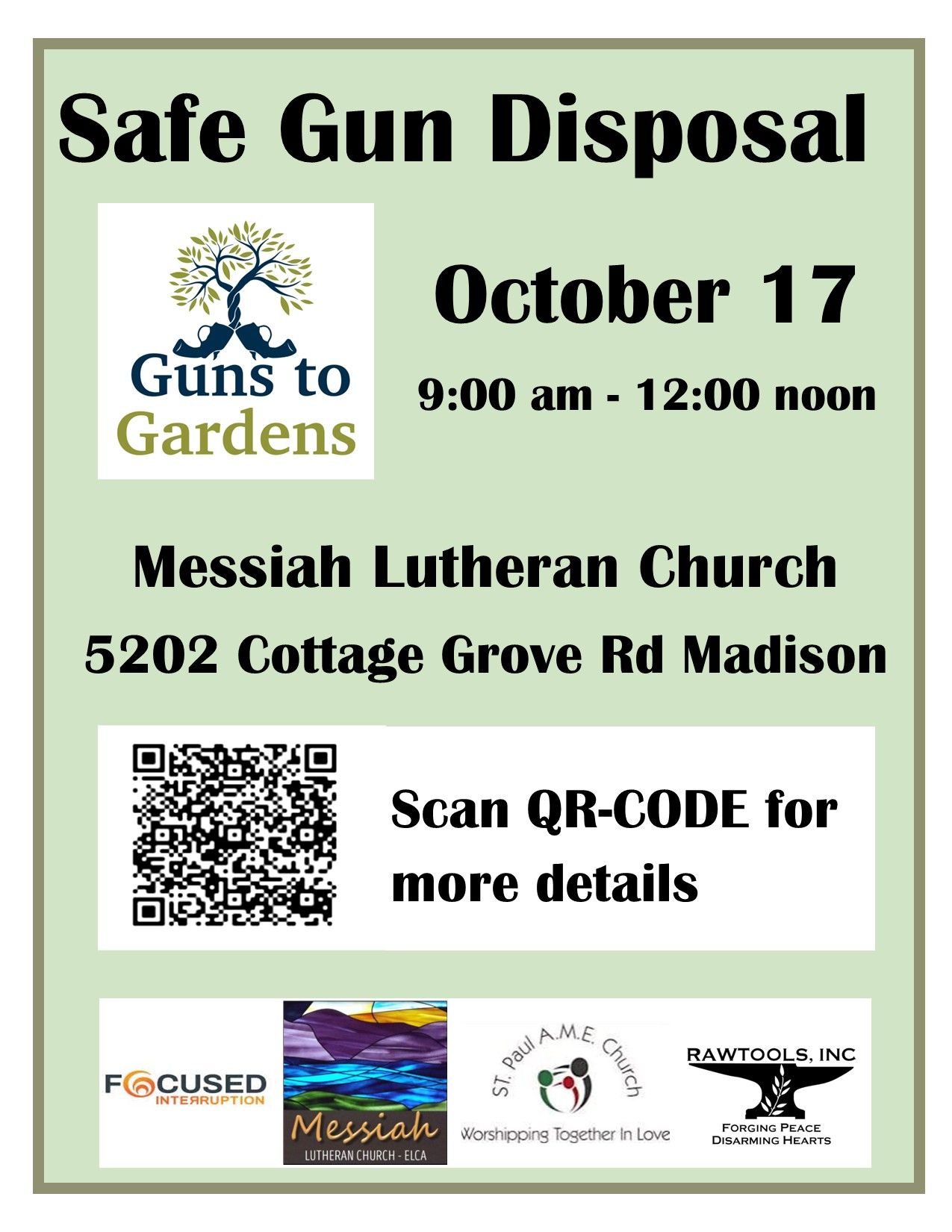
If you cannot attend the event but want information about future events, contact Elizabeth at volunteer@messiahchurch.com.


Passionate About Addressing Gun Violence?
If you were unable to join the When Thoughts and Prayers Aren’t Enough book study, but you are still passionate about addressing gun violence, choose from these action steps. As we learned, thoughts and prayers are a starting point, not the end point.
- Borrow the book from Racial Justice library.
- Join the Messiah Racial Justice Team and receive monthly newsletters.
- Tell the Wisconsin State Assembly you want them to take action on gun violence prevention.
- Sign on here: Protect Our Communities: Prioritize Gun Violence Prevention!
- Join us February 8th between the services in the social hall to learn more about the Guns to Gardens Event and to communicate with our lawmakers about passing effective gun control laws or do it at home by following these links:
- Ron Johnson
- Tammy Baldwin
- WI representatives to Congress
- State Legislators and Governor
- 5 Calls
- Attend the Guns to Gardens Event March 21st to trade in an unwanted firearm, to show your support to see the forging or to volunteer-contact Elizabeth at volunteer@messiahchurch.com to volunteer.
- Learn about the Wisconsin gun laws and how those compare with other states:
- Gun Laws in Wisconsin
- Which states have the ideal laws to prevent gun violence?
- Learn about the racial implications of the 2nd Amendment
Many people believe the 2nd amendment was created to preserve states rights against overreach by the federal government. The Second: Race and Guns in a Fatally Unequal America by Carol Anderson unpacks what was going on historically when the second amendment was being crafted at the Constitutional Convention.
In a nutshell, Haiti was beginning to overthrow its French colonial masters which meant Blacks were seizing that country for themselves. The Haitian Revolution sent an earthquake of fear throughout the United States with people like Thomas Jefferson fearing that the ideas of Black freedom would spread to the new country. The 2nd Amendment was a way to get the southern states to ratify the constitution by providing assurances that they would have access to and control over their militias to put down these anticipated uprisings.
Presbyterian Peace Fellowship
Good News for Gun Violence Prevention from Presbyterian Peace Fellowship, the organization providing the training for our Guns to Gardens event in March.
- The CNN Hero of the Year*** was Quinlen Blackwell of Chicago, whose "Southside Blooms" flower farm prevents gun violence by providing jobs and opportunities for at-risk youth, and by transforming a neighborhood with hope.
- Gun violence deaths decreased from 41,044 in 2024 to 38,739 in 2025 --- 2,305 lives saved. Suicide gun violence was about the same, with a decrease in homicides and about 100 fewer mass shootings in 2025 than 2024. While these numbers are still painfully too high, evidence-based strategies are working to save lives. Thank you to each person who helped to make this happen. Source: Gun Violence Archive.
- The Presbyterian Peace Fellowship celebrates the ordination to the ministry of gun violence prevention for Rev. Mike Martin of RAWtools, our Mennonite brother and partner in Guns to Gardens.
- The second annual Atwood Institute for Congregational Courage trained and inspired 65 activists who are now leading congregations in gun violence prevention in 21 states and 10 denominations. See a report HERE.
- In spite of the chaos of 2025, Guns to Gardens continues to grow--including into Texas--- and faithful congregations continue to hear the still, small voice of God that calls us to take action, to pray and to keep going in the ministry of gun violence prevention. Congratulations to churches from Georgia to Minnesota to Missouri and many other states for your faithful action and love. You are good news.
***CNN Heroes: An All-Star Tribute is a television special created by CNN to honor individuals who make extraordinary contributions to humanitarian aid and make a difference in their communities. Honorees are introduced during the fall of each year and the audience is encouraged to vote online for the CNN Hero of the Year. Ten recipients are honored and each receive $10,000. The top recipient is chosen as the CNN Hero of the Year and receives an additional $100,000 to continue their work.
Here is information about the opportunity from the Presbyterian Peace Fellowship, the group which has trained us to host our Guns to Gardens event on March 21. They usually ask for a donation and the racial justice group can make that donation if you like.
Please contact Elizabeth if you are interested in signing up.
"Protecting Children from Gun Violence" Action Circles Feb 4- March 4, 2026 or April 15- May 13.
The sessions are held on Zoom for one hour each Wednesday at Noon
If you are troubled by gun violence as the number one killer of American children, you are not alone. The Presbyterian Peace Fellowship invites you to register for a new Action Circle to learn practical ways that you and your congregation can help protect children and youth from gun violence. The Action Circles are ecumenical and offered free of charge.
Created and led by educators, parents, pastors and church leaders, the Action Circle will help participants learn about the root causes of gun violence impacting children and youth. Together participants will evaluate various types of effective action, with a goal to help each participant find the best action for their church setting.
Learn more in this Presbyterian News story on the new Action Circles HERE.
Register for the Feb 4-March 4 Action CircleHERE or the April 15-May 13 Action CircleHERE.
For questions, suggestions or to learn Summer and Fall dates, contact gvp@presbypeacefellowship.org